
Frederick County Court Records After a Jail Arrest
For a Frederick County arrest, the first public trail may be an arrest report, a Police-to-Citizen entry, or a booking at Northwestern Regional Adult Detention Center. The court record is different. It begins when the charge is filed, heard, certified, indicted, amended, dismissed, or otherwise handled in a Virginia court. The local prosecutor is the Frederick County Commonwealth's Attorney, not a district attorney, and that office is identified in county materials as led by Hon. Ross Spicer.
Use jail inmate records for custody status, roster search fields, and NRADC booking context. Use jail mugshots for booking-photo law and official request channels. Court records after a jail arrest answer a different question: what charge reached the court, what hearing is next, whether bond or release conditions changed, and whether the case ended in conviction, dismissal, nolle prosequi, appeal, or transfer to another court.
How to Find Frederick County Court Records After an Arrest
Start with the official Virginia Judiciary case information hub. It links the statewide Online Case Information System and separate court systems for circuit, general district, and juvenile and domestic relations matters. Search by Frederick County or the correct court locality, then use the defendant name, case number, or hearing date when those options are available.
- Collect the name, arrest date, case number, charge, and agency from the sheriff arrest report or P2C Recent Arrests when available.
- Search the Virginia Judiciary case information system by locality and defendant name or known case number.
- Check General District Court first for many new criminal and traffic matters, misdemeanor cases, and felony preliminary hearings.
- Check Circuit Court if the case was indicted, certified, appealed, or otherwise moved beyond the first court level.
- For juvenile or domestic-relations cases, expect online limits and use the clerk process rather than assuming a public search result exists.
The Virginia Judiciary case information page is the statewide entry point for court records after a Frederick County arrest.
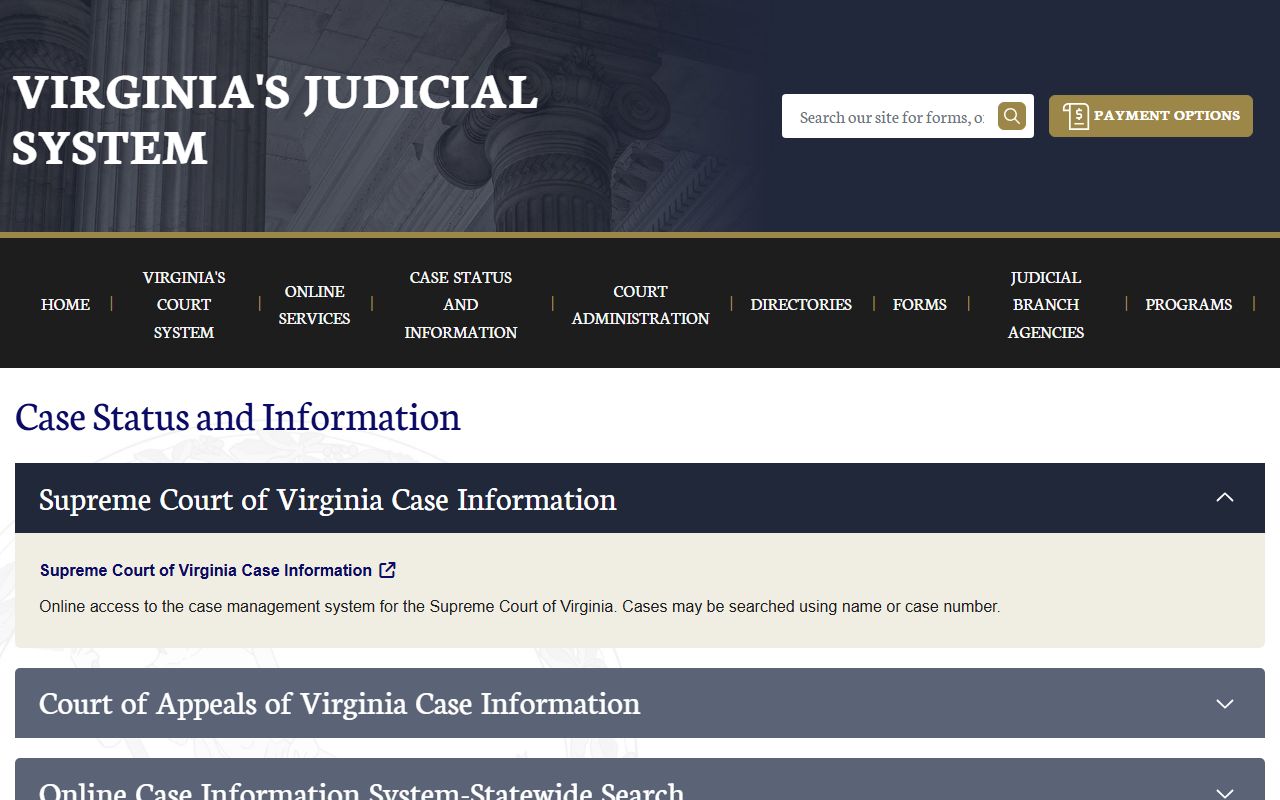
The screenshot matters because it shows the court-record side of the lookup, separate from NRADC custody search and sheriff P2C arrest information.
Court Records, Clerks, and Local Case Channels
The Frederick County courts landing page points users toward local court resources, while the official Frederick Circuit Court page lists Clerk Hon. Sarah J. Kahle, 5 North Kent Street, Winchester, VA 22601-5037, phone 540-667-5770, and public hours of 8:00 AM to 4:00 PM. Circuit Court is important after a felony indictment, appeal, or certified charge. General District Court is often the first place to check for initial criminal proceedings and preliminary hearings.
The official Frederick Circuit Court page provides clerk contact details for circuit-level criminal case records.
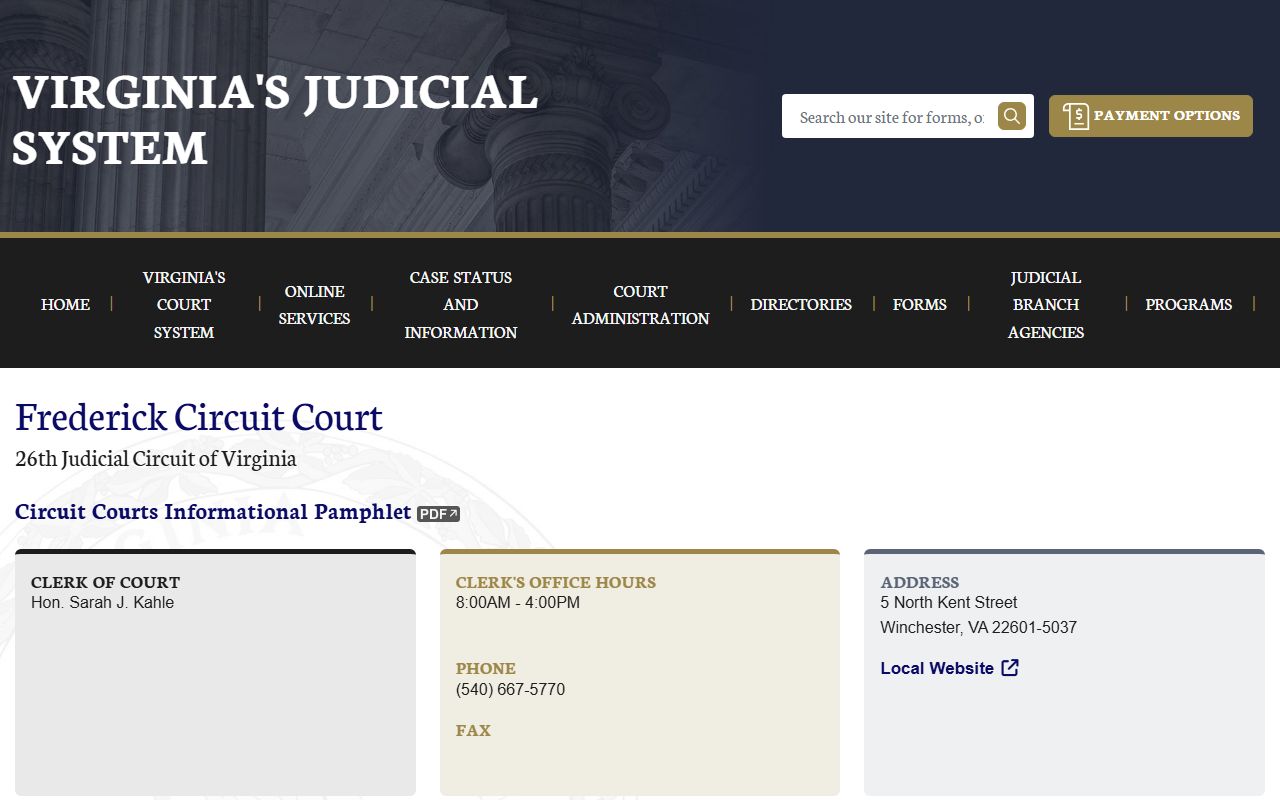
Use the clerk's office for records or questions that the statewide case search does not answer, especially older files, certified copies, or circuit-specific docket questions.
How Charges Get Filed After an Arrest: Complaint, Information, and Indictment
Booking charges at NRADC may be based on the arresting officer's paperwork or warrant. The court case may then proceed by complaint, warrant, information, indictment, or other charging document used in Virginia practice. The Frederick County Commonwealth's Attorney may amend, reduce, dismiss, or take a charge to grand jury, so the first jail charge is not always the final court charge.
| Document or Event | Who Uses It | What It Means After Arrest |
|---|---|---|
| Complaint / warrant paperwork | Officer, magistrate, or complainant process | Starts or supports the accusation that leads to arrest, booking, and an initial court entry. |
| Information or prosecutor filing | Commonwealth's Attorney | Reflects the prosecution's charging decision and may differ from the first arrest wording. |
| Preliminary hearing | General District Court | Tests whether a felony charge should move forward toward circuit-level prosecution. |
| Indictment | Grand jury | Moves or confirms a felony charge in Circuit Court after the grand jury process. |
Charge Status in Court Records After an Arrest
Charge status changes as a case moves from arrest to court. Frederick County's local criminal-court-process material says felony arraignment is generally one to three days after arrest in General District Court, preliminary hearing is generally within 60 days, the grand jury meets on the first Thursday after the first Monday of each month, and circuit trial commonly follows three to six months after grand jury. For misdemeanors, arraignment generally occurs one to seven days after arrest and trial generally within 60 days.
| Status | What It Means |
|---|---|
| Pending | The charge remains active and is waiting for arraignment, hearing, trial, plea, or another court event. |
| Amended / Reduced | The prosecutor or court has changed the charge, level, wording, or code section from an earlier version. |
| Dismissed | The court has ended the charge without a conviction on that count, subject to the exact order entered. |
| Nolle Prosequi | The prosecutor has chosen not to proceed on the charge at that time. |
| Convicted | The case ended in a guilty finding or plea on that charge or an amended version of it. |
Bond and Release After an Arrest
NRADC's booking material says bond is determined by the magistrate during intake. Virginia Code Section 19.2-120 sets the general bail rule for people held pending trial or hearing, while Section 19.2-121 lists factors such as the charge, evidence, residence, employment, financial resources, criminal record, prior court appearances, and risk to public safety or the justice process. Section 19.2-123 describes conditions that may include supervision, travel limits, contact restrictions, secured or unsecured bond, firearm restrictions, treatment conditions, or electronic monitoring.
| Bond Type | How It Works |
|---|---|
| Personal recognizance | Release on a promise to appear and obey conditions, without secured money. |
| Unsecured bond | Release with a promised amount owed if court conditions are violated. |
| Secured / cash bond | Release requires money, property, or other security for the set amount. |
| Surety bond | A bondsman or surety posts security; commercial bail is allowed in Virginia. |
| No-bond hold or detainer | Release is not authorized, or another agency hold prevents release even if local bond is posted. |
The inspected NRADC sources did not provide complete public counter instructions for posting bond. Families should confirm current posting location, payment methods, hours, and active holds with NRADC at 540-535-3800 or with the court or magistrate handling the case.
Warrants That Lead to an Arrest
A warrant can be the event that produces a Frederick County arrest, NRADC booking, and later court record. Virginia Code Section 19.2-72 governs arrest warrants and requires probable cause after sworn examination or complaint. The warrant must identify the accused and the charge, command arrest, and be signed by the issuing officer. Bench warrants and capias events may arise from missed court dates, while search warrants are investigative tools and should not be treated as public arrest-warrant lookup records.
The Frederick County Sheriff's Office contact page lists a Warrants phone line at 540-662-2921. The P2C portal route structure also references Wanted Persons and Most Wanted Persons, but a fully inspected public warrant-result page was not captured in the research. Treat online warrant information as incomplete, and use the sheriff warrants line, court clerk, or counsel for time-sensitive warrant questions.
Charges vs. Convictions
An arrest and charge are accusations. A conviction is a court outcome after a guilty plea, trial verdict, or other final adjudication. Court records after a jail arrest may list several charges that later change or disappear, so do not read a roster charge, arrest report, or pending court entry as proof of guilt.
| Charge | Conviction | |
|---|---|---|
| Stage | Accusation filed after arrest or during prosecution. | Final guilty finding, plea, or judgment on a charge. |
| Proof level | May begin from probable cause or charging review. | Requires the legal standard for conviction in court. |
| Can change? | Yes. Charges may be amended, reduced, dismissed, or not prosecuted. | Changes usually require appeal, modification, expungement, or other court action. |
Sealed vs. Expunged Arrest Records
Virginia Code Section 19.2-392.2 provides the expungement route for eligible police and court records. The research did not locate a separate Frederick County mugshot-removal or court-record-removal policy. Eligibility depends on the disposition and court order, so dismissal, nolle prosequi, or acquittal should be reviewed through the statute, the clerk process, or legal counsel rather than assumed to erase every online trace automatically.
| Sealed / Restricted | Expunged | |
|---|---|---|
| Public visibility | Access is limited or hidden from ordinary public display. | Eligible police and court records are removed from ordinary access by court process. |
| Who may still see it | Access depends on the order, statute, and agency role. | Very limited access may remain under Virginia law and court rules. |
| How it happens | Usually by statute or court order. | By petition and court order under Virginia expungement law. |
Background Check Considerations
Casual court searches are not the same as a legally compliant background check. Employers, landlords, insurers, licensing bodies, lenders, and similar users must follow the Fair Credit Reporting Act and any other applicable law when using criminal-history information for eligibility decisions.
Important: Frederick County Inmate Population is not a consumer reporting agency and may not be used for FCRA-covered decisions.
Restricted Court Records After an Arrest in Frederick County
Not every record connected to an arrest is public online. Virginia Judiciary self-help materials explain that juvenile and domestic-relations case information is limited because of confidentiality. Virginia Code Section 2.2-3706.1 also governs criminal investigative files and criminal incident information, and active or sensitive law-enforcement materials can be withheld or limited. For prosecutor-held records, use the Commonwealth's Attorney FOIA process, recognizing that active prosecution files and investigative material may be restricted.
The Commonwealth's Attorney contact page identifies the office at 107 North Kent Street, Winchester, VA 22601, phone 540-665-6383, with hours Monday through Friday, 8:30 AM to 5:00 PM. For court-file records, use the correct clerk. For jail custody records, use NRADC or the county request channel. Keeping those offices separate prevents a court-record search from being confused with a jail roster, sheriff arrest report, or booking-photo request.
Public Record Search
Sponsored Results